

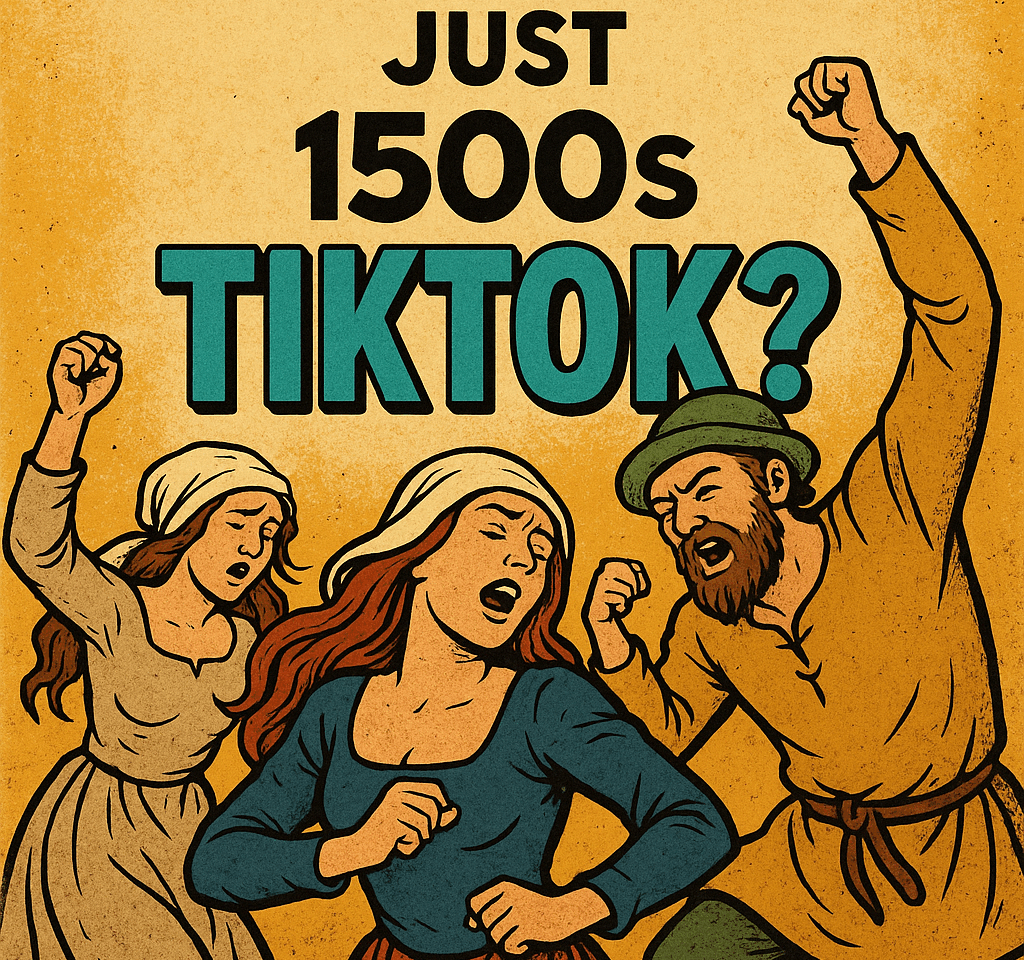
Was the Dancing Plague Just 1500s TikTok? Let’s Talk
By Translator and Author Serena Bader
They danced until their feet bled.
On a hot summer day in 1518, in the streets of Strasbourg, a random woman began to dance. No music. No crowd. Just her moving nonstop. Hours turned into days. Then something strange happened: others joined in. One by one, men, women, even kids, started dancing too. And they couldn’t stop.
People collapsed. Some reportedly died from pure exhaustion. Still, the dancing continued.
Over 500 years later, we’re still talking about it.
And here’s the wild part, when you really think about it, the Dancing Plague of 1518 might not be that different from something you’ve seen on TikTok.
Was it mass hysteria? Or just the 1500s version of going viral?
When Weird Becomes Contagious
What happened in 1518 wasn’t just strange but it spread. And that’s what makes it so fascinating. One woman dancing in the street? Weird, sure. But dozens of people? For days? To the point of collapsing? That’s not just a personal breakdown. It spread like wildfire, way before hashtags or algorithms existed.
The truth is, we’re all more connected than we like to admit. We don’t just share spaces, we share moods, habits, even reactions. One person panics, and suddenly a whole room feels tense. One person laughs, and others follow without knowing why. Psychologists call it emotional contagion, but really? It’s just being human.
You see someone doing something unexpected, especially in public, especially when things already feel off, and your brain kind of pauses, like, “Wait… is this what we’re doing now?”
Back in 1518, life was brutal. The people of Strasbourg were dealing with hunger, disease, and deep uncertainty. There was no therapy, no stress leave, no way to unplug. If one person cracked in public, maybe dancing was the only way their body could scream what their words couldn’t. And when others saw it… maybe something inside them screamed too.
We’d love to believe we’re way more rational now. But are we?
Let’s fast forward to today. You open your phone and see a challenge on TikTok: someone posts a video trying a giant Dubai chocolate, but only takes one tiny bite. Or another person pulls a prank on a stranger, making them freeze like their whole life just flashed before their eyes. You roll your eyes. Ten minutes later, it’s all over your feed. Your friend is doing it. Your cousin is doing it. You start to wonder… should I try it too?
Because here’s the thing: we haven’t changed that much.
We’re still highly sensitive to what’s going on around us, especially when we feel stressed, disconnected, or overwhelmed. Trends give us a sense of control, of community, of identity, just like dancing may have given the people of Strasbourg something to hold onto in the middle of chaos.
Why Stress Makes Us More Susceptible to Viral Trends
Stress isn’t just something we feel individually, it can spread through groups and communities, almost like a virus. When people are under pressure, their brains are looking for ways to handle the chaos and uncertainty around them. This shared stress can lead to what experts call “mass psychogenic responses,” where people start reacting in similar ways, even if there’s no clear cause.
That’s where viral trends come in. When everything feels overwhelming, joining a simple challenge or copying a dance can actually be a way to cope. It gives people a break from their worries, a sense of control, and a way to connect with others. Suddenly, doing a silly prank or trying out a popular challenge isn’t just entertainment, it’s a small act of relief.
And thanks to social media and its lightning-fast sharing, these behaviors spread super quickly. Algorithms push what grabs our attention, so when a trend taps into our emotions, whether stress, excitement, or curiosity, it can blow up overnight.
So, when times are tough, viral trends aren’t just random distractions. They’re part of how we, as humans, come together to handle stress, connect, and find a little joy in the chaos.
So, Are We Really That Different?
Honestly, not really. Sure, the way we connect has changed, from dancing in the streets of Strasbourg centuries ago to scrolling through TikTok today, but the feelings behind it all are the same. We all want to belong, to be part of something bigger, and to show emotions we sometimes can’t put into words.
The Dancing Plague of 1518 might seem bizarre or tragic, but it’s a powerful reminder that these viral moments, whether back then or now, are deeply human. They are about connection, expression, and sometimes just trying to get through tough times together.
So next time you find yourself tempted to join the latest challenge or share a viral video, know this: you’re part of a long line of people who’ve danced, literally or not, to handle whatever life throws at them.
At the end of the day, whether it is a strange dance from centuries ago or the latest viral video on your phone, it all comes down to one thing. We are all just trying to connect, to feel like we belong, to make sense of what is going on, and to find a little comfort in the chaos. So next time you laugh at a silly challenge or get caught up in a trend, remember you are part of something much bigger, a shared human experience that has been going on for centuries. And honestly, sometimes that is exactly what keeps us going.